This post may contain affiliate links to Amazon, Walmart, and other retailers. If you click through and make a purchase, we may earn a commission at no additional cost to you.
Table of Contents
If you’ve ever bought a portable washing machine only to watch it fail to drain properly, with water pooling at the bottom or a hose that “works” only when propped at exactly the right angle, you’re not alone. After digging through hundreds of verified buyer reviews, appliance forums, and manufacturer specs, one pattern kept surfacing: the single biggest source of frustration with portable washers isn’t capacity or noise. It’s drainage. And most buying guides don’t even mention it.
This guide breaks down the real difference between pump-drain and gravity-drain models, which apartment setups each one actually suits, and which specific washers get this right, based on what real owners report after weeks or months of daily use, not just spec sheets.
What’s the Actual Difference Between Pump Drain and Gravity Drain?
Both systems move used water out of the machine after a wash cycle, but they work in fundamentally different ways, and that difference decides whether your setup will be effortless or a daily hassle.
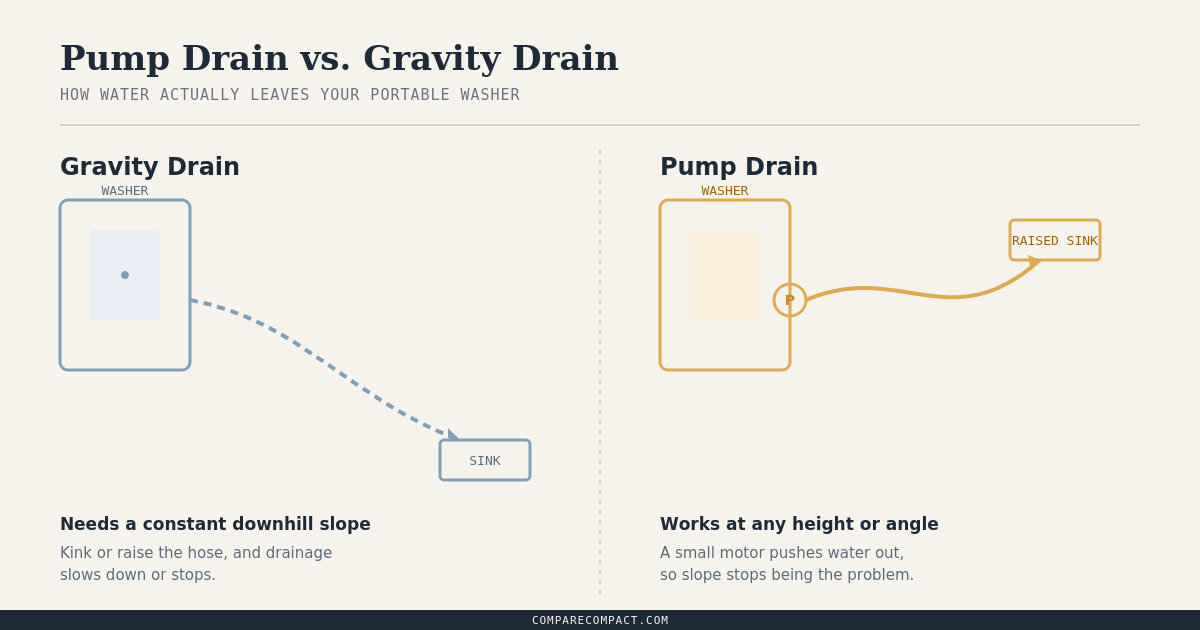
Gravity drain relies on physics alone: water flows down the drain hose because the hose sits lower than the water level inside the machine. There’s no motor pushing it along. This means the hose has to be positioned on a downward slope at all times, usually draining into a low sink, a bathtub, or directly onto the floor toward a drain. If the hose gets kinked, sits too high, or loses its angle even slightly, drainage slows to a crawl or stops working entirely, which is exactly the “water pooling at the bottom” complaint that shows up again and again in buyer reviews.
Pump drain uses a small built-in motor to actively push water out through the hose, regardless of height or angle. That means you can drain into a raised sink, a kitchen counter basin, or even run the hose a few feet away, without worrying about slope. It’s a bit noisier during the drain cycle and it’s one more mechanical part that could eventually fail, but for most apartment setups it removes the single most common source of frustration.
Gravity drain relies on physics alone: water flows down the drain hose because the hose sits lower than the water level inside the machine. There’s no motor pushing it along. This means the hose has to be positioned on a downward slope at all times, usually draining into a low sink, a bathtub, or directly onto the floor toward a drain. If the hose gets kinked, sits too high, or loses its angle even slightly, drainage slows to a crawl or stops working entirely, which is exactly the “water pooling at the bottom” complaint that shows up again and again in buyer reviews.
Pump drain uses a small built-in motor to actively push water out through the hose, regardless of height or angle. That means you can drain into a raised sink, a kitchen counter basin, or even run the hose a few feet away, without worrying about slope. It’s a bit noisier during the drain cycle, and it’s one more mechanical part that could eventually fail, but for most apartment setups it removes the single most common source of frustration.
Quick Reference: Which One Fits Your Space?
| Your Situation | Better Fit |
| Low bathroom sink or tub within reach | Gravity drain works fine, and it’s usually cheaper |
| Kitchen counter setup, raised sink, or no clear downward path | Pump drain is close to essential |
| You live above the ground floor and can’t run a hose to a floor drain | Pump drain |
| You want the simplest, cheapest possible setup and don’t mind occasional troubleshooting | Gravity drain |
| You share walls or floors and want a fast, no-fuss laundry routine | Pump drain |
One more thing worth knowing before you buy: some listings don’t state the drain type clearly in the title or main photos, only in the fine print of the product description or the Q&A section. If a listing doesn’t mention “drain pump” explicitly, it’s almost always a gravity drain by default.
How to Choose the Right Portable Washer for Your Apartment
Before comparing specific models, answer these questions. They’ll narrow your options faster than scrolling through spec sheets.
- Do you have easy access to a sink, tub, or shower stall? If your bathroom sink sits low and you can leave the machine nearby on laundry day, a gravity-drain model will work fine and save you money. If your setup involves a kitchen counter, a raised sink, or any awkward positioning, go with a pump drain. This is the single biggest factor, so start here.
- Do you share walls, floors, or ceilings with neighbors? Spin speed creates most of the noise and vibration. Look for machines with lower RPM settings or a “quiet spin” feature if you’re in an older building or on an upper floor. Twin-tub models tend to vibrate more during the spin cycle than fully automatic single-drum machines, so factor that in if noise is a concern.
- How much laundry do you actually do per week? It’s tempting to buy the largest capacity available, but a bigger drum means a heavier, bulkier machine to store between uses. If you’re washing for one or two people, a 0.9-1.6 cu ft washer is usually plenty. Save the larger capacities for households doing frequent bedding or towel loads.
- Does your lease say anything about portable appliances? Some buildings restrict portable washers, particularly ones that connect to a kitchen faucet, because of water damage concerns. It’s worth a quick check of your lease or a message to your landlord before you buy, especially for models without a built-in drain pump, since a slow or failed gravity drain is the most common cause of overflow complaints.
- Do you have somewhere to store it when it’s not in use? Nearly all portable washers are designed to be rolled or carried into a closet, under a counter, or into a corner between loads. Check the folded or stored dimensions, not just the operating footprint, before deciding.
Compare: 5 Portable Washers by Drain Type
| Model | Drain Type | Capacity | Price | Noise | Amazon Rating |
| COMFEE’ 0.9 Cu.Ft Compact Washer | Pump drain | 0.9 cu ft | ~$250 | Quiet (840 RPM | 4.4★ (8,400+) |
| COMFEE’ 1.6 Cu.Ft Portable Washing Machine | Pump drain | 1.6 cu ft | ~$356 | Moderate | 4.4★ |
| ROVSUN 17.8LBS Portable Washing Machine | Pump drain | 17.8 lbs | ~$220–260 | Moderate | 4.4★ |
| Auertech 28lbs Twin Tub | Pump drain (semi-auto) | 28 lbs | ~$150–180 | Louder | 4.3★ |
| Wonderwash (manual, hand-crank) | No drain hose, manual pour-out | ~5 lbs | ~$50–60 | Silent | 4.1★ |
Capacity is listed as the manufacturer reports it – some use drum volume (cu ft), others use maximum load weight (lbs). As a rough guide, 1 cu ft ≈ 15-18 lbs of laundry capacity.
Notes: prices and ratings change regularly on Amazon, so treat this table as a starting point for comparison rather than real-time pricing. Always confirm current price and availability before buying.
The Full Reviews
COMFEE’ 0.9 Cu.Ft Compact Washer
Best for: Most apartment renters who want a “set it and forget it” experience.
This is the safest starting point for anyone who’s never owned a portable washer, largely because the pump drain removes the one variable that causes the most frustration elsewhere. It offers 5 wash programs and 3 water levels, which covers everything from delicates to everyday loads, and the 840 RPM spin is quiet enough for shared walls without leaving clothes soaking wet. At 0.9 cu ft, it’s sized for one or two people rather than a household, so if you’re regularly washing bedding or towels, it may feel small. With over 8,400 ratings on Amazon and a 4.4-star average, it has one of the largest and most consistent review bases in this category, which matters when you’re trying to judge long-term reliability rather than a handful of early impressions.
COMFEE’ 1.6 Cu.Ft Portable Washing Machine
Best for: Couples or anyone doing regular loads of towels and sheets.
This is essentially the larger sibling of the 0.9 cu ft model, built for people who found the smaller capacity limiting. The stainless steel drum holds up better over time than the plastic drums found in cheaper machines, and it retains the same reliable pump-drain system. The tradeoff is footprint: at 20.7″ × 20.3″, it takes up noticeably more closet or corner space, and it’s heavier to move between uses. If storage space is tight, this is worth weighing carefully against the 0.9 cu ft version before deciding whether the capacity increase is worth the size increase.
ROVSUN 17.8LBS Portable Washing Machine
Best for: Budget shoppers who still want pump-drain reliability.
The ROVSUN sits in an appealing middle ground: it keeps the built-in pump drain that makes daily use easier, but comes in at a lower price than the COMFEE models. Its 26-minute quick wash cycle is one of the fastest in this category, which is a real advantage if laundry has to fit around a tight schedule. Eight wash programs and five water levels give it more flexibility on paper than some pricier competitors. The main tradeoff buyers report is a slightly less durable build over years of heavy use, so it suits light-to-moderate laundry routines better than daily heavy loads.
Auertech 28lbs Twin Tub
Best for: Larger households prioritizing capacity over convenience.
This is a different category of machine entirely: a semi-automatic twin tub, meaning you manually move laundry from the wash side to the spin side rather than the machine handling it in one automated cycle. That extra step is the tradeoff for a genuinely large capacity (28 lbs total, split 18/10 between wash and spin) at a lower price than fully automatic models. It still includes a pump drain, so the drainage headaches this guide opened with don’t apply here. It’s louder and more hands-on than the other picks, but for a household doing frequent, large loads on a budget, the capacity-to-price ratio is hard to beat.
Wonderwash (Manual, Hand-Crank)
Best for: No sink access, ultra-tight spaces, or occasional light laundry only.
This is the true “no drain hose” option on this list. There’s no motor, no pump, and no hose to position at all. You fill it, hand-crank the drum, and pour the water out yourself when you’re done, which means it works even in situations where none of the other four machines would (no accessible sink, no floor drain, no outlet nearby). The tradeoff is real: roughly 5 lbs capacity per load, manual effort every time, and no spin-dry function, so clothes come out wetter than with any powered machine. This isn’t a replacement for regular laundry; it’s a backup solution for genuinely space-constrained situations or occasional handwashing needs.
Frequently Asked Questions
Can a portable washer flood my apartment?
It’s rare, but it happens most often with gravity-drain models where the hose loses its downward angle mid-cycle or slips out of the sink. Pump-drain machines are less prone to this because the motor actively controls water flow rather than relying on gravity and positioning. Whichever type you choose, it’s worth staying nearby during the first few cycles until you’re confident the hose is secure, and checking that connection each time you move the machine.
Do landlords allow portable washers?
It varies by building and lease, so check yours before buying. Some leases specifically prohibit water-connected appliances, particularly kitchen faucet-connect models, due to water damage liability. Buildings with strict no-appliance clauses are more common in older housing stock and larger cities. If your lease is silent on the topic, a quick message to your landlord or property manager is worth the five minutes it takes, especially before spending $200+ on a machine you can’t use.
How long does a wash cycle actually take?
This varies more than most buying guides admit. Quick-wash cycles on fully automatic models often run 25 to 30 minutes, but a full cycle with a longer wash and rinse setting can take 45 minutes to over an hour. Semi-automatic twin tubs generally take longer overall since you’re manually managing the transfer between wash and spin, even though each individual step is fast.
Will a portable washer actually save me money compared to a laundromat?
For most people doing laundry weekly, yes, usually within 3 to 6 months depending on machine price and local laundromat costs. The bigger factor for most buyers isn’t the money though, it’s the time and hassle saved by not hauling laundry out of the building.
If you’re also weighing a portable AC for the same small space, our guide to single-hose vs. dual-hose portable air conditioners breaks down a similar hidden tradeoff that most buying guides skip.
5 thoughts on “Pump Drain vs. Gravity Drain Portable Washers: Which Actually Works for Your Apartment”