This post may contain affiliate links to Amazon, Walmart, and other retailers. If you click through and make a purchase, we may earn a commission at no additional cost to you.
Table of Contents
If you’ve ever bought a portable air conditioner by matching the BTU number to your room size, only to find it still can’t keep up on the hottest days, you’re not alone. BTU (British Thermal Unit) measures how much heat a unit can remove from a room each hour, the higher the number, the stronger the AC is supposed to be. Most buyers stop there. But after digging through independent lab testing, buyer reviews, and manufacturer specs, one pattern kept surfacing: BTU alone doesn’t tell you whether that number will actually hold up once the unit is running in your apartment. The real factor is whether it’s a single-hose or dual-hose design, and that difference can mean the gap between a unit performing at 70% of its rated capacity or 95% of it.
This guide breaks down what single-hose and dual-hose actually mean, why one type quietly loses cooling power the longer it runs, how to size either type correctly, and which models get the balance of performance, price, and noise right for apartment living.
If you’re also dealing with laundry in a tight space, our guide to pump-drain vs. gravity-drain portable washers covers a similar hidden tradeoff.
How the Airflow Actually Works
Both designs use the exact same refrigeration technology inside. The difference is entirely in how they source and expel air.
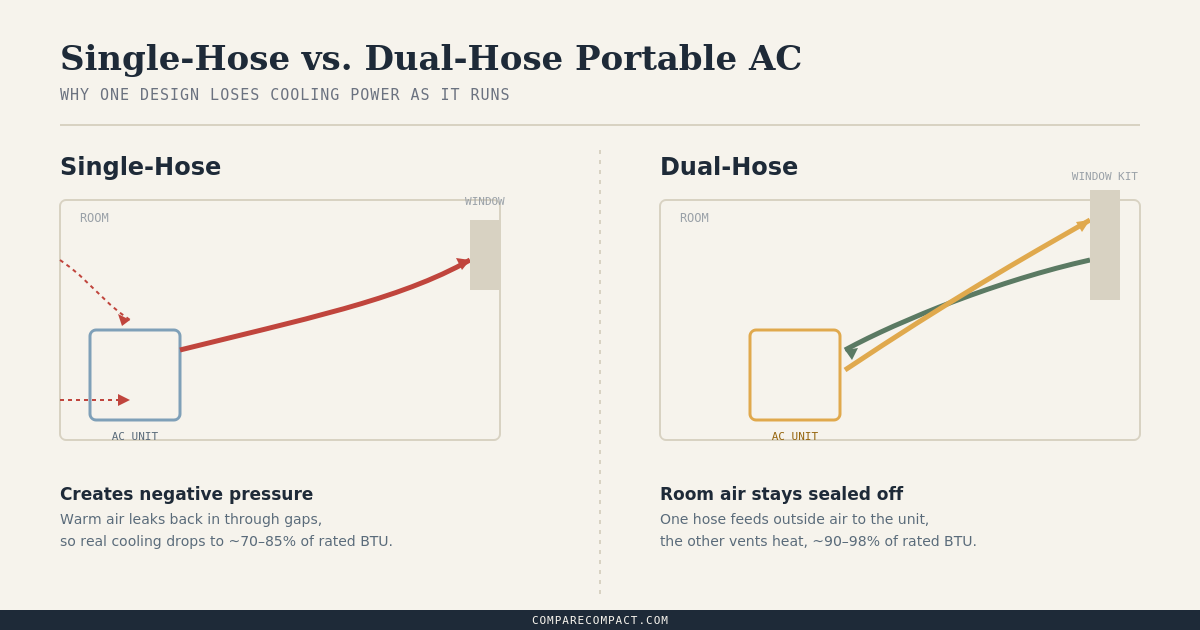
Single-hose units pull air from inside your room, use it to cool the internal condenser coil, then push that same (now hot) air out through the single exhaust hose. The problem: removing air from a sealed room creates negative pressure, and that vacuum pulls replacement air in from wherever it can, gaps around doors, windows, even bathroom vents. That replacement air is usually warm, so the unit ends up fighting a steady trickle of the exact heat it’s trying to remove. In practice, this drops real-world cooling to roughly 70–85% of the rated BTU capacity.
Dual-hose units separate the two air paths entirely. One hose pulls air from outside to cool the condenser; the second hose sends that hot air back outside, never touching your room’s air supply. Without the negative-pressure effect, dual-hose units typically deliver 90–98% of their rated capacity, and the gap widens further as outdoor temperatures climb.
How Noise Fits Into the Decision
Noise is where the single-hose vs. dual-hose debate gets less clear-cut, and worth explaining properly rather than oversimplifying.
The intuitive assumption is wrong. You’d expect a dual-hose unit, with two air paths instead of one, to be louder. In practice, it’s the opposite trend more often: single-hose units frequently run their compressor and fan continuously at higher speeds because they’re fighting the negative-pressure infiltration problem, which can push sustained noise to 52–56 dB. Dual-hose units cycle their compressor on and off less often since they reach and hold the
| Your Situation | Better Fit |
| Small room (under 250 sq ft), budget is the priority | Single-hose works fine, and it’s usually $50–150 cheaper |
| Larger room, sun exposure, or a hot climate | Dual-hose holds its rated performance much better |
| Running the AC for a few hours occasionally | Single-hose is simpler to set up and store |
| Running the AC daily for a full summer | Dual-hose saves more on electricity over time |
| Bedroom where noise matters most | Check the specific model’s dB rating, not hose count |
How to Choose the Right Portable AC for Your Apartment
Before comparing specific models, answer these questions.
- How big is the room you’re cooling, in square feet? As a rough starting point, budget 30–35 BTU per square foot for single-hose units (to compensate for infiltration losses) and 20–25 BTU per square foot for dual-hose units. A 250 sq ft bedroom needs roughly 8,000–9,000 BTU either way, but a 450 sq ft living room needs closer to 12,000–14,000 BTU, and hose type matters more as the room gets bigger.
- How hot and sunny does the room get? West-facing windows, direct sun, or a top-floor apartment all increase real heat load. In sustained high heat, the performance gap between single- and dual-hose widens significantly, so lean toward dual-hose if your space runs hot.
- Will this run for a few hours or most of the day? Occasional spot-cooling favors single-hose (cheaper, simpler). Daily, all-summer use favors dual-hose (the efficiency gap adds up on your electric bill).
- Does noise matter more than efficiency? If the unit will run in a bedroom overnight, prioritize a published dB rating at or below 50, and a working sleep mode, over hose type specifically.
- Do you have space and window access for two hoses? Dual-hose units need a slightly more involved window kit and floor space for two hose runs instead of one. If your window setup is awkward or space is very tight, that’s a real practical constraint.
- Do you need to drain condensed water manually? Most modern units in both categories use auto-evaporation to expel most moisture through the exhaust hose, but very humid climates may still require occasionally emptying an internal tank. Check this per model rather than assuming.
- Check your outlet and circuit first. Most portable ACs run on a standard 120V, 15-amp outlet, but units above roughly 14,000 BTU may need a dedicated 20-amp circuit. Never use an extension cord, always plug directly into the wall, and check what else shares that circuit, since a fridge or microwave on the same line can trip the breaker when the AC kicks on. Also confirm the outlet has a standard three-prong grounded plug; older buildings sometimes still have two-prong outlets that will need an adapter or an electrician’s fix. This is general guidance, not electrical advice specific to your home; if you’re unsure, consult a licensed electrician before installation.
| Model | Hose Type | BTU | Price | Noise |
| BLACK+DECKER BPACT08WT | Single-hose | 9,000 | ~$300 | ~52 dB |
| Dreo 318S | Single-hose | 8,000 | ~$400–440 | 46 dB |
| ZAFRO Smart Inverter | Dual-hose | 10,000 | ~$440 | ~42–45 dB |
| Whynter ARC-122DS Elite | Dual-hose | 12,000 | ~$400–450 | <52 dB |
| Gasbye Dual Hose | Dual-hose | 14,000 | ~$500 | 45 dB |
The Full Reviews
BLACK+DECKER BPACT08WT
Best for: Small rooms and renters who want the simplest, cheapest setup.
This is the straightforward entry point into portable cooling: a single-hose unit rated at 9,000 BTU (5,300 SACC), sized for rooms up to roughly 400 sq ft. It includes the standard 3-in-1 modes (cool, fan, dehumidify) and a “Follow Me” remote that reads the temperature near you rather than at the unit itself. The tradeoff is the one this whole guide is about: as a single-hose design, expect real-world cooling closer to 70–85% of that rated capacity once negative pressure kicks in, especially in a room with poor sealing around windows and doors. For a small, well-sealed bedroom used a few hours a day, that’s a reasonable compromise for the price. For anything larger or hotter, it will struggle to keep up.
Dreo 318S
Best for: Anyone who wants the quietest single-hose option and hates emptying water tanks.
The Dreo stands out in two ways that matter for apartment living. First, at 46 dB sound pressure, it’s meaningfully quieter than most single-hose units in this category, closing much of the noise gap that usually favors dual-hose designs. Second, it uses a genuinely drainage-free system: it auto-evaporates condensed water through the exhaust air in environments under 90% humidity, so you’re not stuck manually emptying a tank every few hours. It’s still single-hose, so the same negative-pressure efficiency loss applies, and at 8,000 BTU (5,000 SACC) it’s best suited to a bedroom or single room rather than an open living space. If quiet operation and low maintenance matter more to you than raw cooling power, this is the strongest single-hose pick here.
ZAFRO Smart Inverter 14,000 BTU
Best for: Genuinely quiet dual-hose cooling at close to its full rated capacity, without paying flagship prices.
This is a genuinely well-reviewed dual-hose pick that fills the gap between the smaller units above and the largest flagship models. It is rated 14,000 BTU (10,000 BTU SACC), and that SACC number matters more than the headline BTU figure since it reflects real-world cooling capacity. Like the other dual-hose units here, the separated intake and exhaust design means it holds close to its rated capacity even as a room heats up over the day, instead of losing efficiency to negative pressure the way single-hose units do. It runs at a quiet 42 dB, includes drainage-free operation for most humidity conditions, and app control if you want to adjust it remotely. The tradeoff is the same one that applies to every dual-hose unit: two hose runs through the window kit instead of one, and a bulkier unit to store when the season ends.
Whynter ARC-122DS Elite
Best for: Balanced performance and price for a mid-to-large room.
The ARC-122DS sits in a comfortable middle ground: 12,000 BTU (7,000 SACC) of dual-hose cooling, rated under 52 dB, at a price that undercuts many single-purpose “quiet” units despite doing more work. The dual-hose design means it holds close to its rated capacity even as the room heats up over the course of a day, which single-hose units in this BTU range typically can’t match. It includes auto-drain functionality, so condensed water is handled automatically rather than requiring a manual reservoir dump in most conditions. For anyone cooling a living room or a room with more heat gain (sun exposure, multiple occupants), this is a reasonable step up from the smaller dual-hose picks without jumping to flagship pricing.
Gasbye Dual Hose 14,000 BTU
Best for: Larger rooms, hot climates, or anyone who wants maximum cooling headroom and does not mind the strongest fan noise of the group.
This is the strongest unit in the lineup: 14,000 BTU of dual-hose cooling rated for spaces up to 500 sq ft, with a full DC inverter compressor for more efficient, quieter operation than a fixed-speed compressor. It runs at 45 dB, competitive for a unit this powerful, and includes drainage-free cooling for most humidity conditions plus a backlit remote. This tier is built for rooms or conditions where the quieter, lower-BTU options above would simply run constantly and never quite catch up: sun-drenched living rooms, top-floor apartments, or genuinely hot climates where sustained performance matters more than shaving off a few extra decibels. It’s not the right pick for a small, well-insulated bedroom, where you would be paying for cooling power you don’t need.
Frequently Asked Questions
Do I need a window for either type of portable AC?
Yes, both single-hose and dual-hose units need a window (or occasionally a wall opening) to vent hot air outside; that part doesn’t change based on hose type. What differs is the installation itself: dual-hose units use a slightly bulkier window kit to accommodate two hose connections instead of one, and you’ll want to make sure your window style (sliding, double-hung, casement) is compatible before buying.
Is a single-hose unit just a “bad” choice?
Not necessarily. For a small, well-sealed room used a few hours a day, a single-hose unit can perform perfectly well and cost meaningfully less. The efficiency gap widens as the room gets larger, the climate gets hotter, or the unit runs for longer stretches, so the “right” choice depends on your specific situation rather than one type being universally better.
What should I check about my electrical outlet before buying?
Most portable ACs run on a standard 120V, 15-amp outlet, but units above roughly 14,000 BTU may need a dedicated 20-amp circuit. Never use an extension cord, always plug directly into the wall, and check what else shares that circuit, since a fridge or microwave on the same line can trip the breaker when the AC kicks on. Also confirm the outlet has a standard three-prong grounded plug. This is general guidance, not electrical advice specific to your home; if you’re unsure about your outlet, circuit capacity, or wiring, consult a licensed electrician before installation.
Will a dual-hose unit actually lower my electric bill?
Generally yes, if you run it daily over a full season. Because dual-hose units reach and hold their set temperature more efficiently, they cycle the compressor less often, which adds up to real savings over weeks of daily use. For occasional or short-term use, the efficiency gap has less time to offset the higher upfront cost.
Does a higher BTU number always mean better cooling?
Not by itself. BTU tells you the unit’s rated capacity under lab conditions, but hose type, room size, insulation, and sun exposure all affect how much of that rated capacity you actually get. A correctly sized dual-hose unit can outperform a higher-BTU single-hose unit in the same room.
4 thoughts on “Single-Hose vs. Dual-Hose Portable AC: 5 Models Compared”