This post contains affiliate links. As an Amazon Associate, I earn from qualifying purchases at no additional cost to you.
You measure your closet door, order the organizer that claims to hold “36 pairs,” and it arrives looking exactly like the photos. Then you try to load your actual shoes into it. Your flats and ballet slippers slide in fine. Your sneakers barely close the pocket flap. Your ankle boots don’t fit at all: the pocket is too shallow and too narrow, and the boot’s shaft just folds over the top and hangs there. Most buying guides don’t mention this, because most buying guides are written from the product photos, not from a closet full of mismatched footwear.
The “36 pairs” number on the box isn’t wrong, exactly. It’s just measuring something different than what you assumed: it’s counting pockets, sized for the smallest, flattest shoe in a typical household, a woman’s ballet flat or a flip-flop. Sneakers, running shoes, and boots simply weren’t part of the math. And that’s before you even get to the second problem nobody warns you about: whether an over-the-door organizer will physically work on the door you actually have.
This is the third guide in our small-space storage series, after our comparisons of portable washers and portable air conditioners.
Why “Holds 36 Pairs” Rarely Means What You Think
Every hanging shoe organizer is built around a pocket: a rectangle of fabric, mesh, or clear vinyl sewn to a backing panel. The pocket has a width, a height, and a depth, and all three matter more than the headline “pairs” number.
Depth is the one that trips people up. A pocket built for a flat or a slipper needs maybe 2 to 3 inches of depth. That’s genuinely all a ballet flat requires. But a sneaker, with its raised heel and thicker sole, needs closer to 4 to 5 inches to sit fully inside the pocket rather than bulging out the top. A boot needs even more room, plus somewhere for the shaft to go, something most pocket-style organizers simply don’t provide, because they were never designed with boots in mind despite what the box art sometimes implies.
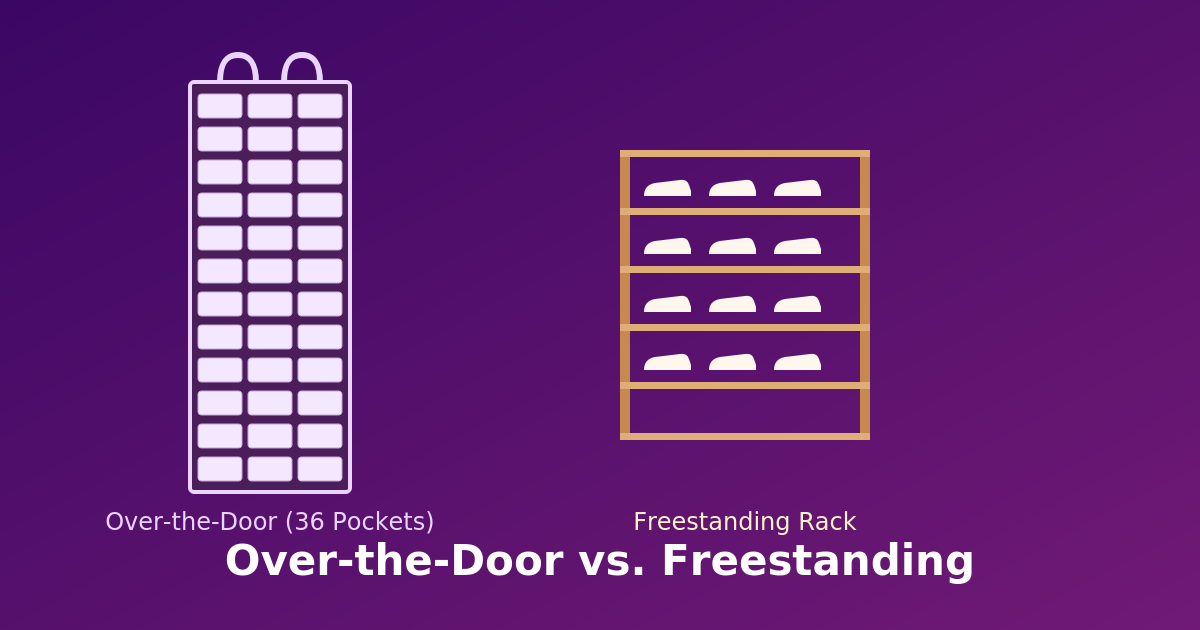
This is where brands’ capacity math starts to diverge, and it’s worth checking before you buy rather than after. Some organizers count one pocket per pair: you fold two shoes together (heel to toe) and stuff them into a single pocket, which is how a 12-tier unit with three pockets per row can claim “36 pairs” from 36 total pockets. Other organizers count one pocket per shoe, so a 24-pocket unit is marketed honestly as holding “12 pairs,” because each shoe gets its own slot. Neither approach is dishonest, but they produce wildly different real-world capacity for the same shelf space, and the packaging rarely spells out which method a given product uses.
The practical fix is simple but easy to skip: before ordering, find the pocket dimensions (width × height × depth) in the product listing, not just the total pocket count, and compare them against your bulkiest pair of everyday shoes, not your smallest. If the listing doesn’t state pocket depth at all, that’s usually a sign it’s a shallow, flat-shoe-only design.
The Second Problem: Does It Actually Fit Your Door?
Assuming the pockets are deep enough, the next question is whether the organizer can even hang where you want it to. Over-the-door units work by hooking over the top edge of a standard hinged door: the hooks rest on the door’s top edge and the panel hangs down the back. That design assumes a few things that aren’t true of every door in a home:
Standard interior doors are about 1⅜ inches thick; some newer solid-core interior doors and most exterior doors run 1¾ inches. Most over-the-door hooks are sized for something in that general range, but they need to actually reach over the top and grip the back face; if your door is unusually thin (some hollow interior doors run thinner, and many closet doors aren’t standard hinged doors at all), the hooks can sit loosely and let the whole unit tilt or slide sideways under load.
More importantly: a lot of closets don’t use a standard hinged door in the first place. Bifold (folding) doors, sliding doors, and louvered doors don’t have one continuous top edge to hook over: bifold doors fold at a center hinge, sliding doors have no door-shaped frame to hang from at all, and louvered slats can crack under a hook’s point pressure. If your closet has any of these, an over-the-door organizer either won’t mount securely or won’t mount at all, no matter how good the pockets are. It’s worth checking your actual door type before ordering; this is the single most common reason these organizers arrive and never get used.
Weight is the last piece. A fully loaded 24- to 36-pocket organizer stuffed with real shoes typically adds somewhere in the range of 15 to 25 pounds hanging off the top of the door. Interior doors and their hinges are generally rated to handle roughly 45 to 100 pounds of hanging load, so a single organizer is usually fine, but the load sits entirely on the door’s top edge and hinges rather than being distributed, which is why cheaper hinges can sag slightly over months of daily open-and-close use, and why the door may stop closing flush against the frame (the hooks add just enough bulk at the top to catch on the frame). None of this means an over-the-door organizer will damage a normal door, but it’s the reason a freestanding rack is sometimes the better call for narrow, bifold, sliding, or louvered doors, or simply for anyone who doesn’t want a door that occasionally sticks.
Quick Reference: Which Type Fits Your Situation
| Your situation | Better fit |
|---|---|
| Standard hinged closet or bedroom door, mostly flats/sandals | Standard-pocket over-the-door organizer |
| Standard hinged door, mostly sneakers | Deep-pocket over-the-door organizer |
| Bifold, sliding, or louvered closet door | Freestanding rack (no door needed) |
| Storing boots or tall shoes | Freestanding adjustable/angled rack |
| Dorm room or rental with a narrow door | Narrow-width deep-pocket organizer |
| Want to avoid any risk to door or hinges | Freestanding rack |
How to Choose: 7 Questions to Ask Before You Buy
- What kind of door does the space actually have? Standard hinged, bifold, sliding, or louvered: this alone rules in or out every over-the-door option before you look at anything else.
- What’s the pocket depth, not just the pocket count? Look for the actual width × height × depth measurement in the listing. Anything under about 3 inches of depth is built for flats and slippers, not sneakers or boots.
- How is “pairs” being counted? One pocket per pair (fold shoes together) or one pocket per shoe? Divide accordingly to get the real number of individual shoes it holds.
- Do you need it to hold boots? If yes, a pocket-style organizer usually isn’t the answer regardless of brand; look at freestanding angled or adjustable racks instead.
- How much daily traffic does the door get? A door that’s opened and closed dozens of times a day with a heavily loaded organizer will show wear on the hinges faster than a rarely used closet door.
- Does the unit’s hook design match your door’s thickness? Check the listed door-thickness range against your own door; most standard interior doors fall around 1⅜ inches, but measure yours rather than assuming.
- Safety checklist: if you have young kids or pets, confirm the organizer’s hooks are secured well enough that a hard tug (a toddler grabbing a low pocket, a dog jumping up) won’t pull the whole unit down. Freestanding racks eliminate this risk entirely since there’s nothing to pull loose from a door.
The 5 Organizers Compared
| Model | Type | Pocket depth/style | Claimed capacity | Price (verified on Amazon, Sept 2026) |
|---|---|---|---|---|
| Whitmor 36-Pair Over-the-Door | Over-door, metal & mesh | Shallow, 1 pocket per pair | “36 pairs” (folded together; real-world reviews report closer to 24) | ~$34–42 depending on color |
| Simple Houseware 24-Pocket Clear | Over-door, clear PVC pockets | 2.75″ deep, 1 pocket per pair | 24 pairs | ~$14 |
| ZOBER 12-Pocket Mesh | Over-door, breathable mesh | 3″ deep, medium pockets (7.5″×5.5″) | 12 pockets | ~$10 |
| STORAGE MANIAC Deep Pocket | Over-door, narrow-door design | 9.84″ deep, fits up to men’s size 13 shoes or size 12 boots | 16–23 pairs (10-pocket version) | ~$20 |
| mDesign 3-Tier Adjustable/Expandable | Freestanding, angled rack | No pockets, open angled shelves, expands to 31″ per level | Fits shoes and boots, capacity scales with width used | ~$32 |
Prices confirmed in stock and current as of early September 2026. Amazon prices change often, so check the live listing before publishing a link.
The Full Reviews
Whitmor 36-Pair Over-the-Door Shoe Organizer
Best for: renters with a standard hinged closet door and mostly flat or low-profile shoes who want the lowest-cost option.
This is the organizer most people picture when they hear “over-the-door shoe rack”: a 12-tier metal-and-mesh grid that hooks over a standard door with three pockets per row. The “36 pairs” figure is the manufacturer’s count of folded-together pairs in shallow pockets, but it’s worth setting expectations from actual buyers rather than the box: in the organizer’s own Amazon reviews, one buyer with women’s size 8 shoes reports fitting closer to 24 pairs, not 36, and another notes their sneakers had to be squeezed in sideways because the shelves aren’t deep enough for anything but low-profile shoes. The iron-and-mesh construction itself is sturdy for the price, and the hooks are adjustable enough to handle minor variation in door thickness. This is a solid pick for flats, sandals, and kids’ shoes, just don’t expect the literal number on the box if your household wears sneakers or boots.
Simple Houseware 24-Pocket Clear Over-the-Door Organizer
Best for: people who want to see their shoes at a glance and mostly store flats, sandals, or kids’ shoes.
The clear PVC pockets are the main selling point here: you can identify a pair without unloading three rows to find it. At roughly 2.75 inches of pocket depth, it’s built for the same flat-shoe category as the Whitmor, just with better visibility and a slightly sturdier four-hook mount. It’s not a boot or sneaker solution, and the clear vinyl will show scuffs over time, but for an entryway of everyday flats it’s a solid, inexpensive option.
ZOBER 12-Pocket Mesh Over-the-Door Organizer
Best for: a narrow door, or households who want fewer, larger pockets instead of many shallow ones.
ZOBER takes the opposite approach from the Whitmor and Simple Houseware: instead of packing in as many pockets as possible, it uses just 12 mesh pockets on a narrow 12-inch-wide panel, each one roughly 7.5″ x 5.5″ with about 3 inches of depth. That’s more breathing room per shoe than the flat-pocket organizers above, and the breathable mesh helps sneakers air out instead of trapping moisture the way solid vinyl does. It’s a good fit for a narrow closet door specifically, though at 3 inches of depth it’s still built for shoes, not boots.
STORAGE MANIAC Deep-Pocket Over-the-Door Organizer
Best for: dorm rooms, narrow doors, and anyone whose main complaint with other organizers is that shoes don’t fully fit in the pocket.
This is the organizer built specifically around the depth problem: it’s marketed for narrow and dorm-style doors and uses larger, deeper pockets designed to fully enclose a sneaker rather than leave the toe hanging out. It comes in several tier counts (roughly 6 to 20 pockets depending on the version), so you can match capacity to a narrower door instead of being locked into one fixed width. It’s still a pocket-style organizer, so boots are out of scope, but for sneakers and athletic shoes specifically, the deeper pocket is the meaningful upgrade over the standard designs above.
mDesign 3-Tier Adjustable/Expandable Shoe and Boot Rack
Best for: bifold, sliding, or louvered closet doors, boot storage, or anyone who’d rather not hang 20+ pounds off their door at all.
This is the freestanding alternative, and it solves both problems in this guide at once: it doesn’t need a hinged door to hang from, so it works in closets with bifold, sliding, or louvered doors where every organizer above simply can’t mount, and its open, angled-shelf design fits boots and tall shoes that no pocket organizer will accommodate. The tradeoff is floor space: it sits on the closet floor rather than using otherwise-wasted door space, and its per-pair capacity is lower than the pocket organizers above. For boot storage or a non-standard door, though, it’s the only option on this list that actually works.
FAQ
Will an over-the-door organizer work on my closet door?
Only if it’s a standard hinged door with a single continuous top edge. Bifold, sliding, and louvered closet doors (all common in US homes) don’t have that top edge to hook over, so an over-the-door organizer generally won’t mount securely, or won’t mount at all. Check your door type before ordering rather than after.
How many shoes will these organizers actually hold?
Less than the “pairs” number on the box implies for anyone with sneakers or boots. Check the individual pocket dimensions (not just the pocket count) and whether the brand counts one pocket per pair or one pocket per shoe; those two numbers can differ by half.
Will a heavily loaded organizer damage my door or hinges?
A single organizer, even fully loaded, is well within what standard interior door hinges are rated to hold. The more common complaint is the door no longer closing fully flush against the frame because the hooks add bulk at the top edge: annoying, but not damage. Hinges can develop a slight sag over months of daily use with a heavy load, which is worth knowing if the door gets opened dozens of times a day.
Are freestanding boot racks better than over-the-door organizers?
For boots specifically, yes: pocket-style organizers weren’t designed to hold a boot shaft, so a freestanding angled or adjustable rack is the more realistic option. For flats, sandals, and sneakers, over-the-door pocket organizers are usually the more space-efficient choice since they use door space that would otherwise go unused.
What door thickness do these organizers fit?
Standard interior doors run about 1⅜ inches thick, with some solid-core interior doors and most exterior doors closer to 1¾ inches. Most over-the-door hooks are designed around that general range, but measure your own door and check the listed compatible thickness rather than assuming; a mismatch is the most common reason these hooks sit loosely or let the unit tilt.