This post may contain affiliate links to Amazon, Walmart, and other retailers. If you click through and make a purchase, we may earn a commission at no additional cost to you.
You buy the no-drill shelf that claims to hold 15 pounds. You load it up with a few paperbacks and a small plant, well under the limit on paper. A week later, it is hanging at an angle, or it is on the floor. The 15-pound rating was real; it just was not tested the way your wall actually works: smooth drywall, ideal humidity, and the full surface area of the adhesive strip pressed on correctly. Textured paint, a slightly uneven wall, or a strip that was not held for the full cure time can cut that number by half or more.
This is the fourth guide in our small-space storage series, after we compared portable washers, portable air conditioners, and shoe storage.
| Model | Mount Type | Weight Capacity | Price | Reviews |
| Command Display Ledges | Adhesive strips | 2 lbs | $11.29 | 14,014 |
| OAPRIRE Acrylic Floating Shelves | Adhesive tape, no drill | Light items only | $24.99 | 1,637 |
| BAYKA Floating Shelves | Hidden bracket, wall anchors | Moderate loads | $20.98 | 10,963 |
| Homeforia Solid Pine | Screws into stud | 50 lbs per shelf | $59.99 | 6,534 |
| Amazon Basics 5-Tier Ladder | None, freestanding | Moderate loads | $62.99 | 8,623 |
How the Mounting Types Actually Differ
Adhesive strips (Command, OAPRIRE) rely on surface contact and cure time. The rated weight assumes clean drywall, room temperature, and 24 to 48 hours before you hang anything. Textured or freshly painted walls, humidity, or loading the shelf early all cut real capacity, often by half. These are best for light, decorative items you are fine with occasionally repositioning or replacing.
Hidden wall-anchor brackets (BAYKA) sit between the two extremes. They do not need a stud, but they do need a hole and a drywall anchor rated for the load. Properly installed, they hold more than adhesive and leave a small, easily patched hole rather than a large screw hole. Improperly installed into weak or damaged drywall, they fail the same way adhesive does.
Screws into a stud (Homeforia) are the only option here rated in real pounds you can trust without caveats, because the load goes into solid framing rather than the wall surface itself. The tradeoff is you need a stud in the right spot, a stud finder, and in most rentals a landlord’s permission to drill, plus the holes to patch when you move out.
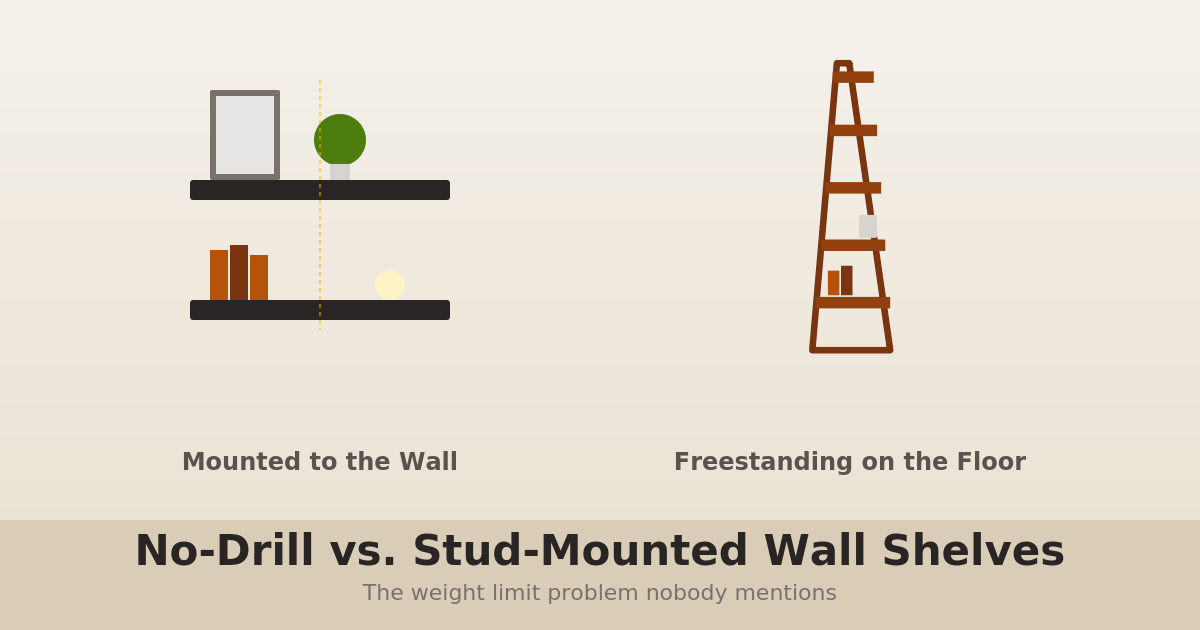
Freestanding shelving (Amazon Basics ladder) sidesteps the whole question. Nothing attaches to the wall, so there is no weight-limit guessing game and no landlord approval needed, but it takes up floor space a wall-mounted option would not.
How to Choose the Right Wall Shelf for Your Rental
Start with what your lease actually allows. Some rentals permit small nail or anchor holes but not larger screw anchors; others are strict about any wall penetration. If you are not sure, ask before you buy rather than after you have already committed to a mounting type.
Match the mount to what you are actually storing. A few books or a small plant is well within adhesive range once you account for real-world derating. Anything heavier, or anything you would be upset to find on the floor, belongs on a stud-mounted or freestanding option instead.
Check your wall type before you order. Adhesive and most drywall anchors assume standard painted drywall. Plaster, tile, brick, and heavily textured walls all behave differently, and some adhesive products explicitly say they are not rated for those surfaces.
The Full Reviews
Command Display Ledges
Best for: renters who want zero wall damage and only need to hold light, decorative items.
This is the safest possible option for a security deposit: the 3M adhesive strips leave no visible mark on painted drywall when removed correctly. At a 2-pound rating per ledge, it is built for small frames, a candle, or a couple of paperbacks, not a real storage solution. With over 14,000 reviews, it is also the most proven pick in this list by a wide margin. If your goal is decoration rather than storage, this is the lowest-risk way to get it.
OAPRIRE Acrylic Floating Shelves
Best for: a smart speaker, a small plant, or anything else you want tucked into a corner without drilling.
This no-drill shelf relies on stronger adhesive tape rather than Command-style strips, which puts it a step up from pure decoration without crossing into real storage territory. It is genuinely useful for the specific job it is designed for, tucking a smart speaker or small plant out of the way, and the compact footprint means it fits corners a full-size shelf could not. Treat the manufacturer’s weight claim as a ceiling under ideal conditions, not a number to plan around.
BAYKA Floating Shelves
Best for: anyone who wants a real everyday-use shelf and can put a small anchor hole in the wall.
This is the clearest middle ground in the lineup. The hidden bracket sits inside the shelf itself, so from the front it looks fully floating, and it mounts with a drywall anchor rather than requiring a stud. That means you get meaningfully more real capacity than adhesive, at the cost of a small hole rather than none at all. With nearly 11,000 reviews and a number one Best Seller badge, it is the most battle-tested pick for people who want to store things, not just display them.
Homeforia Solid Pine Shelves
Best for: real storage weight when you have permission to drill and know where your studs are.
This is the only shelf in the lineup with a weight rating you can plan around without mental math: 50 pounds per shelf, because the hardware goes into the stud rather than relying on the wall surface. Solid pine construction also means you can sand and refinish it instead of replacing it if it gets scratched. The catch is permission and prep: you need a stud in a usable spot, a stud finder to confirm it, and, in most rentals, a green light from your landlord before you drill. If all three line up, this shelf won’t disappoint you six months in.
Amazon Basics 5-Tier Ladder Shelf
Best for: anyone whose lease bans wall mounting entirely, or who just does not want to deal with the question.
This option opts out of the entire mounting debate. It leans against the wall rather than attaching to it, so there is no adhesive to fail, no anchor to install, and nothing to ask a landlord about. Five tiers of solid rubberwood give you real shelf storage rather than a single small ledge, and Amazon’s Choice badge plus over 8,600 reviews suggest it holds up over time. The real cost is floor space rather than wall space: this is a piece of furniture, not a shelf, and it needs somewhere to stand.
Frequently Asked Questions
Do no-drill shelves actually damage walls?
Removed correctly, most quality adhesive strips do not damage painted drywall: you stretch the strip downward rather than pulling straight out, which releases the bond. If you remove them the wrong way, or leave them on textured or damaged paint, they can pull off a layer of paint. Test on an inconspicuous spot first if you are worried about your specific wall.
How do I find a stud without an expensive tool?
A basic magnetic or electronic stud finder costs under 15 dollars and is accurate enough for shelving. As a rough backup check, look for existing nail or screw marks from baseboards, outlets, and switch plates, which are usually attached to studs and spaced 16 inches apart on center in most US construction.
Can I mix mounting types in the same room?
Yes, and it is often the most practical approach. Use a stud-mounted or freestanding option for anything heavy or important to you, and save adhesive or anchor shelves for lighter, more decorative pieces where a lower weight ceiling is not a real limitation.
1 thought on “No-Drill vs. Stud-Mounted Wall Shelves: The Weight Limit Problem Nobody Mentions”